Net Peptide Content vs. HPLC Purity: Why a 10 mg Vial Isn't 10 mg of Peptide
HPLC purity and net peptide content measure different things. See how counterions, water and TFA change how much peptide is really in a vial.
- Reviewed by
- Zorva Lab Research Team
- Published
- Updated
Two numbers on a peptide certificate of analysis look alike but answer different questions. "99% pure" does not mean 99% of the powder is your peptide. Here is how purity, net peptide content and vial content relate, with worked examples.
What's the difference between purity and net peptide content?
HPLC purity is typically the target peptide's peak area as a share of the integrated peaks, measured by UV detection at around 210–220 nm. Net peptide content is the share of the powder's weight that is peptide rather than counterions and moisture. The two are not equivalent (Bachem).
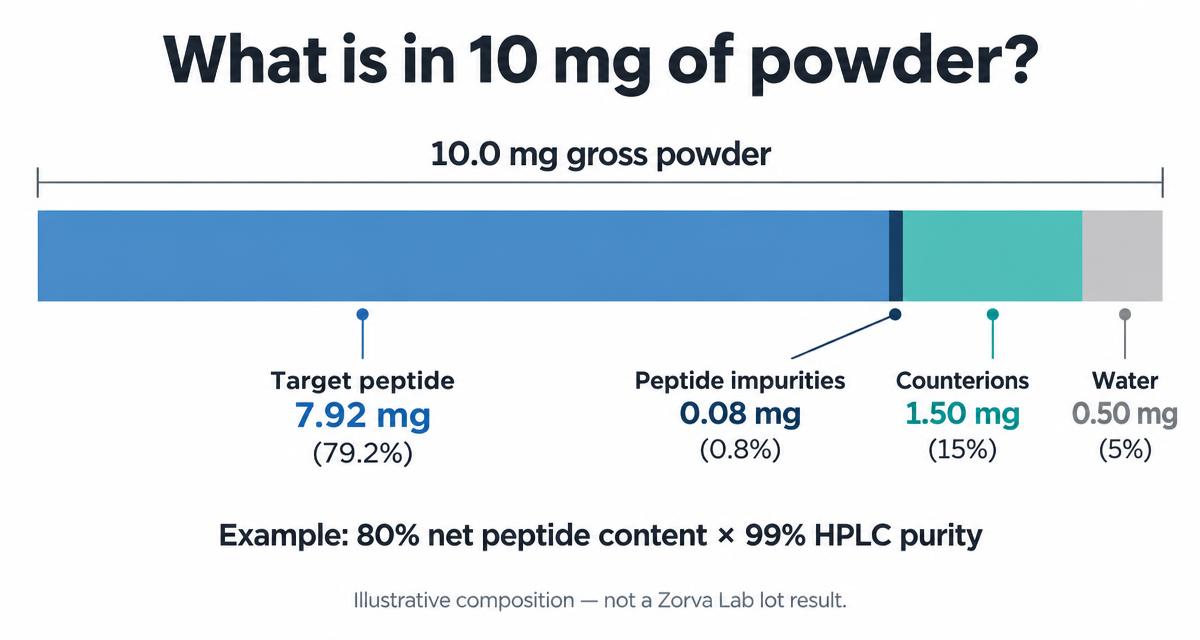
Purity cannot account for components that do not appear as integrated peptide peaks, such as water and most counterions. A lot can be 99.5% pure by HPLC and still be 75% peptide by weight.
For what HPLC and mass spectrometry each confirm, see HPLC vs. Mass Spectrometry: What Each Test Confirms.
Why isn't a lyophilized peptide 100% peptide?
Because peptides are often purified and freeze-dried as salts, and they retain some water.
- Counterions. Trifluoroacetic acid (TFA) is commonly used in solid-phase synthesis cleavage and HPLC purification. Trifluoroacetate can remain associated with protonated sites, including the free N-terminus and basic side chains. Suppliers may exchange TFA for acetate or chloride (Bachem; GenScript).
- Water. Freeze-dried peptides can retain bound moisture, particularly hydrophilic sequences. Water content can be measured by Karl Fischer titration (LifeTein).
- Residual solvents and salts may contribute smaller amounts to the gross powder weight.
How do you estimate net peptide content?
For an idealized dry salt, divide the free peptide's molecular weight by that weight plus the mass of its assumed counterions. This is a theoretical estimate; actual counterion stoichiometry depends on the material, and water lowers the peptide fraction further. Labs can measure peptide content by amino acid analysis or elemental analysis rather than relying on this calculation (Bachem; Biosynth).
| Peptide | Molecular weight (g/mol) | Assumed positive sites | NPC as TFA salt | NPC as acetate salt |
|---|---|---|---|---|
| BPC-157 (15 residues) | 1,419.5 | 2 (N-terminus, lysine) | 86.2% | 92.2% |
| KPV (3 residues) | 342.4 | 2 (N-terminus, lysine) | 60.0% | 74.0% |
Counterion masses used: TFA 114.0 g/mol and acetic acid 60.1 g/mol. In these simplified examples, a smaller peptide has a larger salt contribution: KPV's assumed counterions represent roughly 26–40% of its dry salt weight before any water is counted.
What does "10 mg" on the label mean?
It depends on the supplier. Some fill by gross powder weight; others fill so the net peptide, or the assayed amount of target peptide, meets the label. A good COA identifies the measurement basis.
| Measurement | What it tells you | How it's measured |
|---|---|---|
| Gross weight | Total powder, including water and salts | Balance |
| Net peptide content (%) | Share of the powder that is peptide | Amino acid analysis or elemental (nitrogen) analysis |
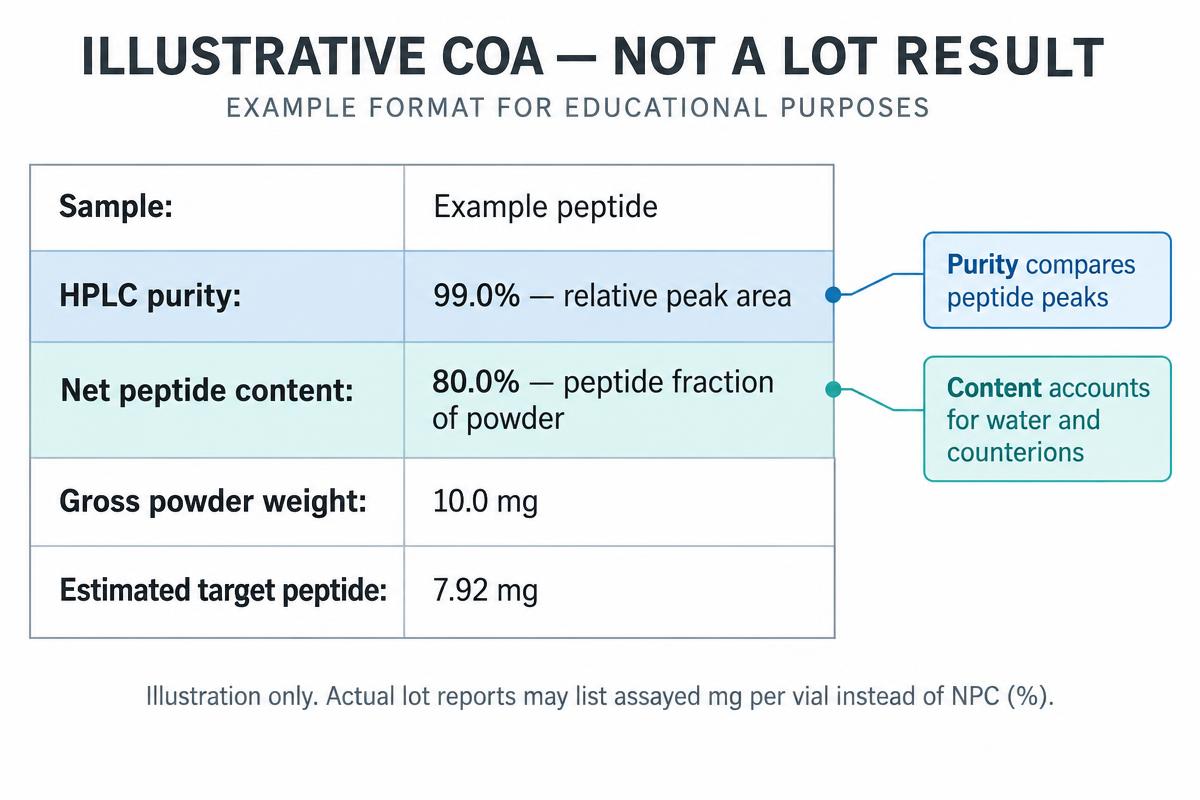
| Assay (mg per vial) | Mass of target peptide in the vial | Validated assay, such as HPLC against a reference standard |
| HPLC purity (%) | Target peak relative to integrated impurity peaks | Reverse-phase HPLC, typically UV at 210–220 nm |
To estimate the target peptide in a vial, multiply gross weight × NPC × HPLC purity. A vial with 10.0 mg of powder, 80% NPC and 99% purity gives 10.0 × 0.80 × 0.99 = 7.92 mg, or about 7.9 mg of target peptide. Peak-area purity is not necessarily a mass fraction because detector responses can differ, so this estimate does not replace a calibrated content assay. For molar work, divide the estimated mass by the molecular weight of the free peptide, not the salt, using consistent mass units.
Why does the counterion matter for in-vitro work?
Residual TFA can change results in cell-based assays. In a 1999 study, TFA salts of amylin, an amylin fragment and calcitonin reduced osteoblast proliferation compared with their hydrochloride salts. That could conceal a proliferative effect or suggest an antiproliferative one. The findings concern the studied experimental systems and should not be treated as a universal threshold for every peptide or cell type (Cornish et al., 1999).
TFA can also affect the pH of unbuffered solutions and interfere with infrared spectroscopy of peptide structure. If your assay is sensitive to these effects, confirm the lot's salt form and residual counterion content rather than inferring them from purity alone.
What should a COA show about content?
- HPLC purity, with the chromatogram and method details.
- Mass-spec identity.
- Content: NPC (%) or mg of peptide per vial, with the method and measurement basis stated.
- Salt form: for example, acetate, TFA or chloride.
- Water content where needed to interpret NPC.
- Lot number and test date that match your vial.
How Zorva Lab reports content
Review the actual lot document in the COA Library for its reported purity, identity and content results. Do not assume that a purity percentage is an NPC result, or that every report uses the same content method. If the measurement basis or salt form is not specified, ask Zorva Lab before using it in calculations. For a field-by-field walkthrough, see How to Read a Certificate of Analysis.
References
- Bachem. Care and handling of peptides.
- Biosynth. Peptide manufacturing: analytics.
- LifeTein. What is net peptide content?
- AAPPTec. Peptide quality FAQ.
- Cornish J, et al. Trifluoroacetate, a contaminant in purified proteins, inhibits proliferation of osteoblasts and chondrocytes. Am J Physiol. 1999;277(5):E779–E783. doi:10.1152/ajpendo.1999.277.5.E779
- GenScript. AccuPep quality: peptide purity and net peptide content.
For research use only. Zorva Lab supplies reference materials for in-vitro laboratory research. Nothing here is medical advice, and no product described is intended for human or animal use.
Frequently asked questions
- Is net peptide content the same as purity?
- No. HPLC purity compares the target peak with other integrated chromatographic peaks. Net peptide content compares peptide material with the powder's total weight, including water, counterions and salts.
- What's a normal net peptide content?
- There is no single value for every peptide. Bachem describes a 70–90% range for research peptides, but NPC varies with sequence, salt form and retained water. Use a measured lot result rather than assuming a standard percentage.
- Does a low NPC mean a bad peptide?
- Not by itself. Small or highly basic peptides may carry proportionally more counterions. Judge a lot on purity, identity and actual content per vial.
- What is TFA in peptides?
- Trifluoroacetate is the counterion associated with trifluoroacetic acid used in synthesis and HPLC purification. It can associate with positively charged sites on the peptide.
- Acetate or TFA salt for cell assays?
- Acetate or hydrochloride salts may be preferable for TFA-sensitive assays because residual TFA has affected cell proliferation in published experiments. Validate the salt form for your specific assay.
- How do I calculate molarity from weighed powder?
- Estimate moles as weighed mass × NPC × purity ÷ molecular weight of the free peptide, with mass in grams and molecular weight in g/mol. Divide by solution volume in liters to obtain molarity. Use NPC and purity as decimal fractions; a calibrated assay is preferable when accuracy is critical.
Verify it yourself
Every Zorva Lab lot has its HPLC and mass spec results published before you order.
Browse the COA library →More research guides
All Zorva Lab products are sold strictly for laboratory research use only. Not for human or veterinary use. This guide is educational and describes laboratory practice only.