99%+ HPLC purityThird-party testedCOA with every lotMass-spec confirmed identityISO/IEC 17025 labsEndotoxin screenedcGMP · US facilitySame-day dispatch · tracked
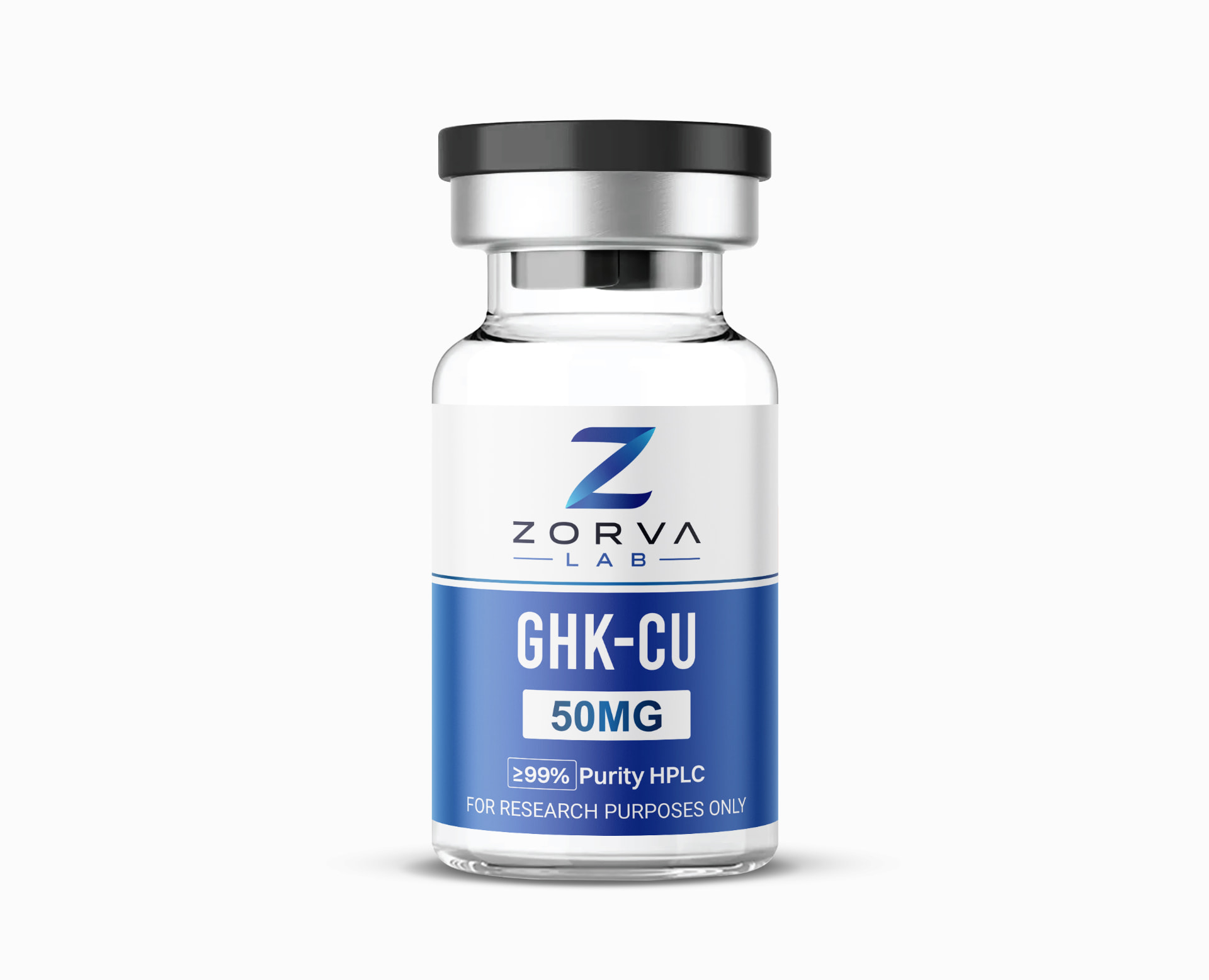
≥99% PurityGHK-Cu vial

GHK-Cu

Collagen Synthesis Studies

$65.00$48.75/vial with BOGO
USA basedcGMP facilityView COA
Quantity
1
Buy 1 Get 1 50% off · auto-appliedAdd 2+ items to cart — every second vial is 50% offOffer Ends 9/15

Same day / next business day dispatch

Free Shipping on orders over $200

Secure Checkout
Third-Party Tested
Money-Back Guarantee
PassedSterility & Endotoxins
PassedNet Content & Purity
Researchers also added
$13.00
$135.00
$65.00
About this compound

GHK-Cu is a copper peptide made of three amino acids. It occurs naturally and was first isolated from human plasma in 1973. It is one of the most studied peptides in skin research. Studies have measured how much collagen skin cells produce after exposure, and how the surrounding tissue structure changes. Levels in plasma fall with age, and that finding is what drove most of the research that followed.

Copper-binding tripeptide

Formula
C₁₄H₂₄CuN₆O₄
Molecular weight
403.9 g/mol
Form
Lyophilized powder
CAS / ID
49557-75-7
0+
Genes Modulated
Gene expression reset toward health
0%
Collagen Increase
Type I & III vs controls
0+
Published Studies
Preclinical research papers
0
Research Areas
Skin Regeneration · Hair Restoration · Gene Expression & more
How It Works

How GHK-Cu works

The pathways GHK-Cu acts on — and what each one does. Signalling pathways studied in preclinical models · illustrative.

Copper Transport & Signaling

Copper Delivery

GHK-Cu chelates copper(II) ions and delivers them to cells, activating copper-dependent enzymes essential for collagen crosslinking, antioxidant defense, and tissue remodeling.

  • High-affinity copper(II) binding
  • Activates lysyl oxidase for collagen crosslinking
  • Supports superoxide dismutase activity
ECM Remodeling & Repair

Collagen Synthesis

Stimulates fibroblasts to produce type I and III collagen, glycosaminoglycans, and decorin — rebuilding the extracellular matrix architecture in damaged tissue.

  • 70% increase in collagen synthesis vs controls
  • Glycosaminoglycan production enhanced
  • Decorin synthesis for matrix organization
Genomic Reprogramming

Gene Modulation

Gene expression studies show GHK-Cu modulates 4,000+ human genes, resetting expression patterns toward a healthier, more youthful state. This is among the broadest gene-modulatory effects of any known peptide.

  • 4,000+ genes modulated toward health
  • Upregulates DNA repair genes
  • Suppresses inflammatory gene expression
Uses & applications

What GHK-Cu is researched for

The main areas GHK-Cu is being studied for — and the study-reported figures behind them.

Dermatology

Skin Regeneration

Stimulates collagen, elastin, and glycosaminoglycan synthesis. Studied extensively in wound healing and anti-aging skin models.

Pickart et al. 2015

Trichology

Hair Restoration

Increases hair follicle size, stimulates follicle growth, and supports hair cycle transition in preclinical models.

Pickart et al. 2012

Genomics

Gene Expression

Modulates 4,000+ genes including DNA repair, antioxidant defense, and anti-inflammatory pathways toward healthier expression patterns.

Pickart & Margolina 2014

Protective

Antioxidant Defense

Chelates free copper, reduces oxidative damage, and upregulates superoxide dismutase — the body's primary antioxidant enzyme.

Maquart et al. 2014

Study-reported magnitudes

Representative figures from published research. Bars fill as you scroll.

  • Collagen Synthesis70%
  • Wound Contraction Rate65%
  • Antioxidant Capacity80%
  • Anti-Inflammatory Effect75%

Figures are representative of published research findings and shown for reference.

Third-Party Verified

Independently tested. Verifiably pure.

Every batch of GHK-Cu is sent to an accredited independent laboratory before it ships. Here is what we screen for.

  • HPLC Purity AnalysisConfirms the peptide is ≥99% pure
  • Mass SpectrometryVerifies the exact molecular identity
  • Heavy Metals ScreeningLead, arsenic, cadmium & mercury — Pass
  • Endotoxins (LAL)Bacterial endotoxin levels — Pass
  • Sterility TestingNo microbial contamination — Pass
  • Net Peptide ContentActual peptide mass per vial verified
Compound Information

Full specification

SequenceGly-His-Lys-Cu(II)
Molecular Weight403.9 Da
Molecular FormulaC₁₄H₂₄CuN₆O₄
FormLyophilized powder
Purity≥99% (HPLC verified)
TestingThird-party HPLC, Mass Spec, Endotoxin
Storage-20°C for up to 24 months
SolubilityWater-soluble
COAIncluded with every order
FAQ

Common questions about GHK-Cu

GHK-Cu (glycyl-L-histidyl-L-lysine copper) is a naturally occurring copper-binding tripeptide first isolated from human plasma in 1973 by Dr. Loren Pickart. It is found in human blood, saliva, and urine, with plasma levels declining from approximately 200 ng/mL at age 20 to 80 ng/mL by age 60.

Preclinical research has demonstrated that GHK-Cu may promote wound healing and skin repair by stimulating collagen and glycosaminoglycan synthesis; attract immune and endothelial cells to injury sites; have anti-inflammatory and antioxidant properties; and modulate the expression of over 4,000 genes toward healthier patterns.

GHK-Cu is not FDA approved as a drug. It is available as a research peptide and is also found in some cosmetic formulations. Injectable forms are sold exclusively for in vitro research purposes.

GHK-Cu has been studied in cultured cell systems and in animal models, where published work examines copper binding, collagen-related gene expression and tissue-repair endpoints. Study concentrations and endpoints differ between publications — consult the primary literature for the parameters used in each experiment.

GHK-Cu consists of three amino acids — glycine, histidine, and lysine — complexed with a copper(II) ion. The molecular formula is C₁₄H₂₄CuN₆O₄ with a molecular weight of approximately 403.9 Da. The histidine residue provides the primary copper-binding site.

Lyophilized GHK-Cu should be stored at -20°C for maximum stability (up to 24 months). Avoid repeated freeze-thaw cycles and protect from light.

For Research Use Only.

Not for human or veterinary use. For in-vitro laboratory research only. These statements have not been evaluated by the FDA; this product is not intended to diagnose, treat, cure, or prevent any disease. Sold exclusively to qualified researchers and institutions.

Back to catalog